Auto detailing & ceramic coating

Marketing for auto detailing businesses

Turn visual proof into booked details, and one-off cleans into recurring customers.

The constraints

What makes this trade difficult.

  • 01

    Enormous price range, poorly understood

    Customers do not know why one detail is $90 and another is $900. Without clear packaging, every conversation collapses into price.

  • 02

    Mobile routing eats the margin

    For mobile operators, jobs scattered across the metro destroy a day. Geographic clustering is the difference between four details and two.

  • 03

    One-time service by default

    Most customers detail once and disappear, despite being obvious candidates for a maintenance schedule.

  • 04

    High-ticket work needs education

    Ceramic coatings and paint correction carry the best margins and the longest explanations. Customers will not buy what they do not understand.

The playbook

What actually works here.

  • 01

    Lead with the visual

    Paint correction and interior transformations are dramatic on video. This is among the most naturally shareable content in any local trade, and it is captured during work you are already doing.

  • 02

    Tier the packages clearly

    Three named packages with visible prices remove the price negotiation and move customers up the ladder. Ambiguity pushes everyone to the cheapest option.

  • 03

    Sell maintenance, not a single detail

    A monthly or quarterly maintenance plan changes customer value dramatically and smooths out a revenue line that is otherwise entirely weather-dependent.

  • 04

    Let people book without calling

    A large share of this audience would rather book online at 10pm than call during business hours. Requiring a phone call loses them.

This trade is made for visual advertising

Detailing produces results that are genuinely satisfying to watch. Swirled paint corrected into a mirror, a trashed interior restored, water beading off a fresh coating — this performs on social media without any production budget, because it is inherently watchable.

That makes Meta and Instagram the natural primary channel for most detailers, and it makes the content essentially free, because it is captured during work that is happening anyway. The operators who do well here are not the ones with the best cameras; they are the ones who remember to film the same angle twice.

Package structure solves the price problem

The most common marketing problem in detailing is not traffic. It is that customers have no idea what things should cost, so every conversation becomes a negotiation and the cheapest option wins by default.

Three clearly named and clearly priced tiers fix most of this. The customer self-selects, the mid tier becomes the obvious choice for most, and the top tier makes the mid tier look reasonable. It also makes advertising far easier, because you can advertise a specific thing at a specific price instead of “call for a quote”.

For shop and mobile operators alike, getting those packages onto the site clearly, with what is included and what it costs, removes most of the friction before anyone makes contact.

Geography decides whether mobile is profitable

Mobile detailing lives or dies on routing. A day with two jobs on opposite sides of Austin is a day mostly spent in traffic.

So the advertising should be geographic before it is anything else — run tight zones, build density, and let the schedule cluster. A campaign targeting the whole metro will produce a scattered calendar that looks busy and earns poorly.

Make maintenance the default

A one-off detail is a transaction. A maintenance plan is a business.

Most detailing customers would happily maintain a car they just paid to have restored, but they are never asked systematically. Automated follow-up at the right interval — timed to the service they bought — converts a meaningful share into recurring work, and it smooths out a revenue line that otherwise swings with the weather.

Booking without a phone call

A substantial part of this audience is younger and strongly prefers to book online. Requiring a phone call during business hours filters out customers who were ready to buy at eleven at night.

Online booking with real availability, deposit capture where appropriate, and automatic reminders reduces both friction and no-shows.

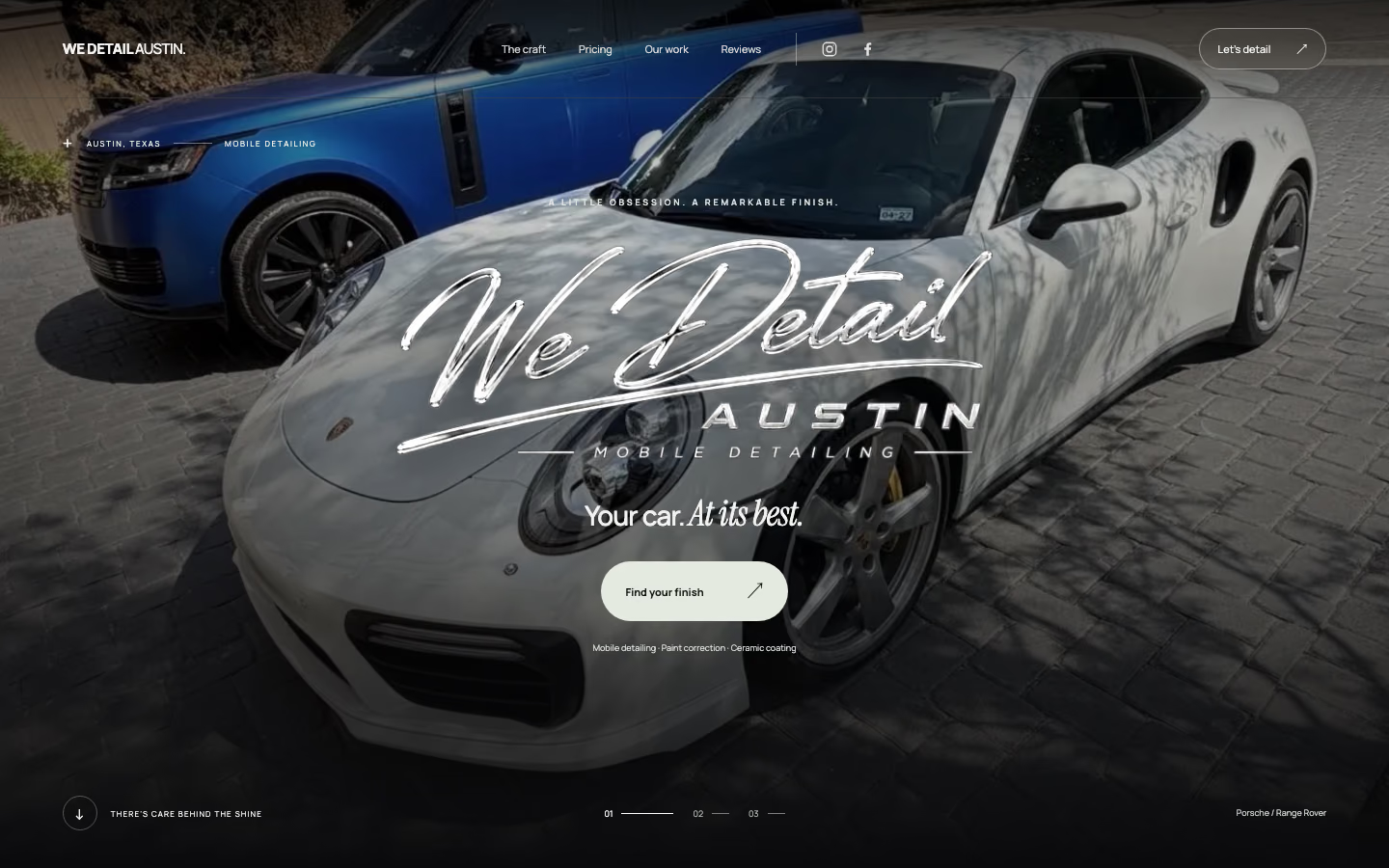
We built the site for a mobile detailing company in Austin recently — you can see it on the client work page.
Questions

Auto detailing & ceramic coating — common questions.

Clear answers before anyone asks you to make a decision.

Ask something else
What marketing works best for auto detailing?

Instagram and Facebook, by some margin. The before-and-after is genuinely compelling to watch and the audience is already there. Search advertising is worth running for high-intent, high-ticket terms like ceramic coating, where the customer is researching deliberately.

How do I sell ceramic coating instead of basic washes?

Educate before you sell. Coatings are expensive and poorly understood, so content explaining what they do, how long they last and why they cost what they cost does most of the work. Then present it as the top tier of a clear package structure rather than a separate upsell conversation.

Should a mobile detailer advertise across the whole metro?

No. Advertise in tight zones and build routes. Two details in the same neighbourhood is a profitable morning; two details forty minutes apart is most of a day gone.

Your next clear step

Make your next growth move a clear one.

Bring your goals. We review your offer, ads, website and follow-up, and identify the single biggest constraint — whether or not we end up working together.

Month to month. Cancel anytime. One client per trade, per service area. No pressure, no hard sell.
CallBook a call